
Affiliate disclosure: This article contains affiliate links. BestEDevices may earn a commission if you buy through them, at no extra cost to you. We mark affiliate links as sponsored and focus this guide on sizing and practical use, not hype.
Quick answer: portable solar generator for refrigerator outage matters because readers need a clear, practical way to compare features, safety, cost, and real-world usefulness before acting. Use this guide to compare watt-hours, surge output, solar input, appliance priorities, and realistic outage expectations before choosing a portable power station.
Table of Contents
Portable Solar Generator For Refrigerator Outage: Key Takeaways
- Start with the exact problem you want to solve, then compare products or fixes against that need.
- Check safety, compatibility, warranty, maintenance, and long-term cost before focusing on price alone.
- Use the original article below for the detailed explanation, examples, and buying notes.
How to Use This Guide
For the best result, read the sections below with your own home, route, appliance, or setup in mind. A good decision about portable solar generator for refrigerator outage should match your space, budget, safety needs, and how often you will use the product or advice.
Official Resource
For extra context, review Ready.gov power outage guidance for backup-power planning and outage safety.
A portable solar generator for refrigerator outage use can be a quiet alternative to a gas generator for short backup needs. It is not magic, though. You need enough battery capacity, enough AC output, and enough surge capacity to start the refrigerator compressor.
Jackery Canada sells portable power stations and solar generator bundles for camping, home backup, RV use, and emergency power. The right model depends on the appliances you need to run, how long the outage lasts, and whether you can recharge from solar, wall power, or a vehicle.
Check Jackery Canada portable power stations
Start With the Refrigerator, Not the Generator
Before shopping, find the refrigerator label or manual. You want the running watts and, if available, the startup or surge watts. Refrigerators do not draw constant power all day; the compressor cycles on and off. That is why a simple watt-hour estimate is only a starting point.
A rough formula is:
Estimated hours = power station usable watt-hours / average refrigerator watts
Because real conditions vary, leave a buffer. A refrigerator in a hot room, a freezer packed with warm food, or a unit with a hard compressor start can use more energy than expected.
What Specs Matter Most?
- Battery capacity: Measured in watt-hours. More capacity means longer runtime.
- AC output: The power station must handle the refrigerator running load.
- Surge output: Compressor startup can require more power than running.
- Solar input: Higher solar input can recharge faster in good sun.
- Battery chemistry: LiFePO4 models often offer longer cycle life than older lithium-ion designs.
- UPS behavior: Some stations support backup switching, but you should verify the exact model before relying on it for sensitive electronics.
What Should You Power First?
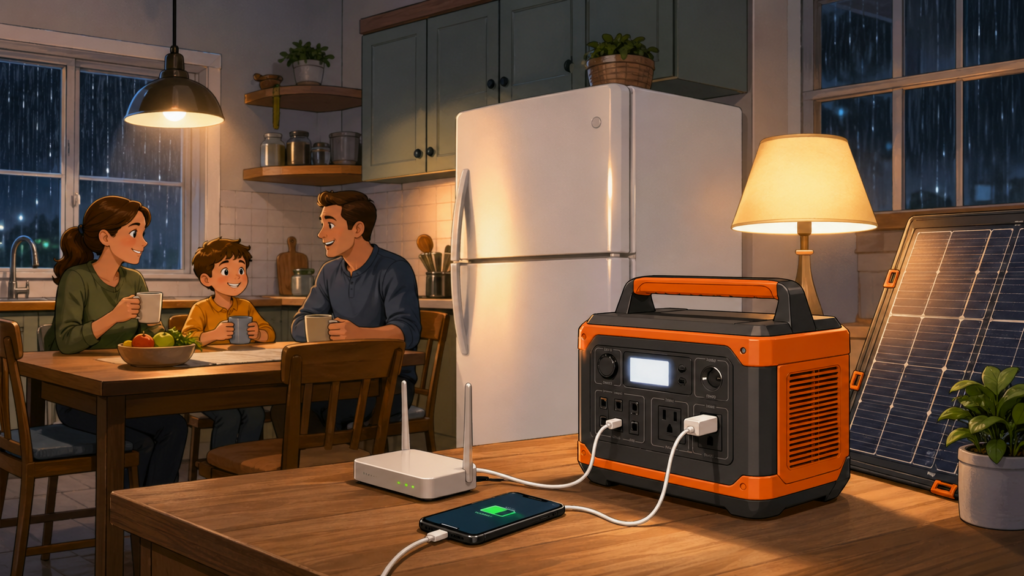
During a short outage, prioritize the refrigerator, phone charging, a modem or router, and one LED lamp. Avoid space heaters, large microwaves, electric kettles, hair dryers, and other high-watt appliances unless your power station is specifically sized for them.
The most common mistake is buying a power station for every appliance at once. A better plan is to build a simple emergency list and size around that list. If the goal is refrigerator plus Wi-Fi, the buying decision is very different from whole-home backup.
Solar Panels Help, But They Are Not Unlimited
Solar charging depends on panel size, sun angle, weather, shade, temperature, and cable setup. If you live in a cloudy region or expect winter storms, solar should be considered a bonus recharge path, not the only plan. Charge the power station before storm season and test your setup before an actual outage.
Related Guides on BestEDevices
- Refrigerated Foods and Power Loss: How Long Can You Keep Your Food Safe?
- Top 10 Best Battery Generator for Home
FAQ
Can a portable solar generator run a refrigerator overnight?
Possibly, but it depends on the refrigerator, the power station capacity, compressor surge, temperature, and how often the door is opened.
Is a solar generator safer indoors than a gas generator?
Yes. Battery power stations do not create exhaust like gas generators. Gas generators must never be used indoors, in garages, or near open windows.
Should I buy the biggest model I can afford?
Not always. Bigger models cost more and weigh more. Buy for your actual emergency load, then add capacity if your budget and storage space allow.
Bottom line: For refrigerator backup, calculate the load first, then compare Jackery or similar power stations by watt-hours, AC output, surge capacity, and recharge options.
Related Guides on BestEDevices
- Cheap Domain Hosting for Affiliate Website: A Beginner Setup Guide
- Electric Scooter With 12 Inch Tires: Is It Better for Rough Roads?

It is our joy to share all of our knowledge on engineering projects with you. Our review can help you maximize the benefits of your project report.